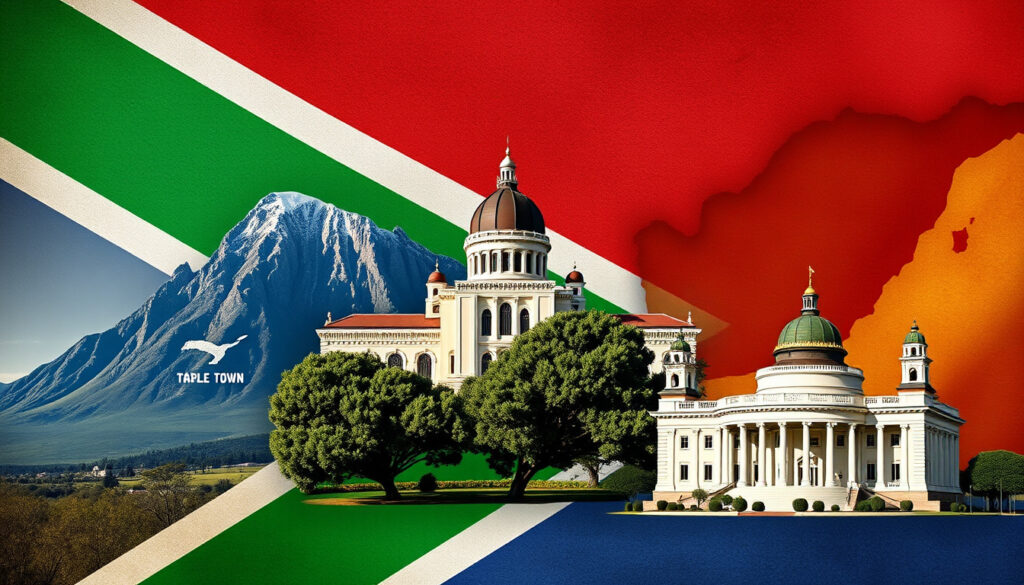
Capital of South Africa: Pretoria, Cape Town, Bloemfontein
Ask any traveler to name South Africa’s capital and you’ll likely get a blank stare or a guess between Johannesburg and Cape Town. The honest answer—a nation with three cities sharing one crown—catches most people off guard. This article untangles the setup: which city does what, why it happened, and what that means for anyone mapping the country.
Administrative Capital: Pretoria ·
Legislative Capital: Cape Town ·
Judicial Capital: Bloemfontein ·
Number of Capitals: 3 ·
Largest City: Johannesburg
Quick snapshot
- Three official capitals serve different government branches (Government Communication and Information System (official government record))
- Pretoria hosts executive offices and most foreign embassies (Wikipedia (constitutional details))
- Cape Town holds Parliament where national laws are debated (SimCorner (travel guide))
- Bloemfontein houses the Supreme Court of Appeal (SimCorner (travel guide))
- No single city carries the legal title “capital” in South Africa’s Constitution (Wikipedia (constitutional details))
- International conventions sometimes cite Pretoria as sole capital without official mandate (Wikipedia (constitutional details))
- 1910: Union compromise created the three-capital system (U.S. Department of State (authoritative historical timeline))
- 1994: Constitutional Court settled in Johannesburg instead (YouTube (explanation of judicial exception))
- 1997: New constitution maintained the arrangement (U.S. Department of State (authoritative historical timeline))
- The tri-capital system remains stable with no active reform proposals (Council on Foreign Relations (think tank analysis))
- Pretoria continues to handle diplomacy while Cape Town hosts legislative sessions (Wikipedia (constitutional details))
- Tourism and business travelers benefit from understanding which city serves which function (Council on Foreign Relations (think tank analysis))
The three capitals house distinct branches of government, each with different constitutional origins and modern roles. Below is the key facts table showing how responsibilities split across Pretoria, Cape Town, Bloemfontein, and Johannesburg.
| Role | City | Province | Notes |
|---|---|---|---|
| Administrative / Executive | Pretoria | Gauteng | Houses President’s offices, government ministries, most embassies |
| Legislative | Cape Town | Western Cape | Seat of Parliament; Constitution specifies Cape Town |
| Judicial | Bloemfontein | Free State | Home to Supreme Court of Appeal |
| Constitutional Exception | Johannesburg | Gauteng | Constitutional Court sits here since 1994 |
What is the capital of South Africa currently?
South Africa has no single capital in the traditional sense. Instead, three cities share the responsibilities that one city handles in most countries. Pretoria serves as the administrative capital, Cape Town as the legislative capital, and Bloemfontein as the judicial capital (Government Communication and Information System (official government record)). This arrangement means the executive, legislative, and judicial branches each have their own seat of power.
Administrative role of Pretoria
Pretoria handles the executive branch. The President’s offices, most cabinet ministries, and the bulk of foreign embassies are located here. The city has approximately 2.5 million metro residents and sits in Gauteng Province, the economic heartland that also contains Johannesburg (SimCorner (travel guide)). Pretoria was declared the capital of the South African Republic back in 1860, giving it a head start in the role it still holds today (Explore South Africa (historical dates)).
Overview of the three capitals
Foreign diplomats almost universally list their embassies in Pretoria, which makes it the de facto choice for international correspondence—but this convention has no basis in constitutional text.
Cape Town, with roughly 4.8 million metro residents, is the largest of the three by population. Bloemfontein is the quietest of the trio, home to about 460,000–500,000 people in its metro area and serving primarily as a judicial hub (SimCorner (travel guide)). The Constitutional Court, established in 1994 as part of the post-apartheid constitutional framework, sits in Johannesburg rather than in any of the three capitals—a notable exception to the established system (YouTube (explanation of judicial exception)).
Is Cape Town or Johannesburg the capital?
Neither Cape Town nor Johannesburg is the sole capital. Cape Town holds the legislative capital title—it hosts Parliament where national laws are debated and passed. The Constitution explicitly names Cape Town as the seat of Parliament, though that can theoretically be changed by parliamentary act (Wikipedia (constitutional details)). Johannesburg is South Africa’s largest city by population and its economic center, but it holds no capital status at the national level.
Cape Town as legislative capital
Cape Town became the legislative capital partly because of its parliamentary tradition inherited from British colonial rule. Founded as a Dutch settlement in 1652, the city later fell under British control in 1814 and developed strong institutions for representative governance (Explore South Africa (historical dates)). The scenic Table Mountain backdrop hides serious political machinery: both the National Assembly and the National Council of Provinces meet here during parliamentary sessions.
Johannesburg as economic hub not capital
Tourists and investors often assume Johannesburg, as the biggest city, must be the capital. This confusion costs nothing in casual conversation but matters when filing visa paperwork or scheduling government meetings.
Johannesburg generates roughly the same GDP as some mid-sized European countries. It hosts the Constitutional Court, the highest court for constitutional matters since 1994, but that does not make it a capital city (YouTube (explanation of judicial exception)). The city’s airports and conference centers see heavy traffic from executives who may never realize they are not visiting the seat of government.
Why does South Africa have 3 capitals?
The three-capital system emerged as a political compromise when the Union of South Africa formed on May 31, 1910. Leaders fused the two former Boer republics—the South African Republic (Transvaal) and the Orange Free State—with the British Cape Colony and Natal Colony. Nobody wanted to hand a symbolic victory to rival regions, so power split across three cities to keep the arrangement balanced (Council on Foreign Relations (think tank analysis)).
Historical reasons for split
- The Boer War (1899–1902) ended with Boer republics incorporated into the British Empire
- Pretoria represented Transvaal interests, Bloemfontein the Orange Free State, Cape Town the Cape Colony
- Bloemfontein hosted a conference in 1899 attempting to prevent the Boer War, giving the city symbolic weight
- All three capitals reflect Boer and British influences that shaped modern South Africa
Roles of each capital
Each capital city handles a distinct branch of government, creating a distributed system that spans different regions and populations of South Africa.
| Capital | Branch | Key institutions | Metro population |
|---|---|---|---|
| Pretoria | Executive | President’s office, cabinet ministries, embassies | ~2.5 million |
| Cape Town | Legislative | Parliament (National Assembly, NCOP) | ~4.8 million |
| Bloemfontein | Judicial | Supreme Court of Appeal | ~460,000–500,000 |
| Johannesburg | Constitutional | Constitutional Court | ~6 million (largest city) |
The comparison shows how South Africa distributes its highest institutions across three major metros and one outlier, balancing population size against institutional placement.
Post-1994 proposals to consolidate capitals in Pretoria or build a new administrative city were rejected—the logistics of moving established institutions and the symbolism of the distributed arrangement proved too daunting (Council on Foreign Relations (think tank analysis)).
South Africa became a republic on May 31, 1961, but the capital arrangement stayed unchanged. The new constitution that entered force on February 3, 1997, similarly preserved the three-capital system, codifying what had become an institutional tradition rather than a legal requirement (U.S. Department of State (authoritative historical timeline)).
Which is the real capital city of South Africa?
Technically, all three are real capitals with distinct official roles. South Africa’s Constitution does not designate a single “capital city”—the document names Cape Town as the seat of Parliament and implicitly treats Pretoria as the executive center, but no clause says “the capital of South Africa is X” (Wikipedia (constitutional details)). This constitutional gap is why the question has no clean answer.
No single capital
The distributed system deliberately avoids concentrating power. Pretoria runs government ministries; Cape Town runs Parliament; Bloemfontein runs the main appeals court. Visitors seeking government services often need to know which city handles their specific need (Timbuktu Travel (policy rationale)).
Pretoria most commonly cited internationally
Most foreign embassies sit in Pretoria, and international mailing addresses routinely list “Pretoria, South Africa.” Yet this convention arose from diplomatic tradition, not constitutional mandate—the Constitution itself names Cape Town as Parliament’s seat.
When a traveler fills out a visa application, the consular section will likely be in Pretoria. When a business owner researches South African corporate law, the Companies and Intellectual Property Commission operates from Pretoria. These practical realities make Pretoria feel like the primary capital even without legal exclusivity (Wikipedia (constitutional details)).
Is Johannesburg the capital of SA?
Johannesburg is not a capital city at any governmental level. The nation’s largest city by population functions as the financial and cultural hub, generating economic output that rivals some national economies, but it holds no constitutional role in national governance.
Johannesburg in Gauteng province
- Johannesburg lies in Gauteng Province alongside Pretoria
- The province is the smallest but most populous in South Africa
- Both cities form a contiguous urban corridor
- Gauteng contains roughly a quarter of South Africa’s population on less than 2% of its land area
Pretoria as Gauteng administrative capital
While Pretoria serves as the national administrative capital, it also functions as the provincial capital for Gauteng—where Johannesburg itself is located. This nested arrangement means Gauteng residents interact with Pretoria’s provincial government for regional matters while national affairs also route through the same city. The Constitutional Court sits in Johannesburg because the post-1994 constitution placed it there specifically, not because Johannesburg holds any traditional capital status (YouTube (explanation of judicial exception)).
Resulting from negotiations between the British Empire and the defeated Boer republics that ended the second Anglo-Boer war and created the Union of South Africa were three capitals.
— Council on Foreign Relations (think tank analysis)
It has remained this way ever since, both because of the logistical difficulties of changing it and because it aligns with South Africa’s diversity.
— Timbuktu Travel (travel blog)
For visitors and investors alike, the practical takeaway is straightforward: Pretoria handles diplomacy and government administration, Cape Town handles legislation, and Bloemfontein handles appellate courts. Johannesburg handles commerce and constitutional law from its own courthouse. Planning a trip or filing paperwork means knowing which city serves your purpose—guessing Johannesburg or Cape Town based on fame alone invites delays.
Related reading: How to Prune Roses
Frequently asked questions
What is the administrative capital of South Africa?
Pretoria serves as the administrative capital, housing the President’s offices, cabinet ministries, and most foreign embassies.
How many capitals does South Africa have?
South Africa has three official capitals: Pretoria (administrative), Cape Town (legislative), and Bloemfontein (judicial).
What is the capital city of Gauteng?
Pretoria is the capital of Gauteng Province. Johannesburg, the largest city in Gauteng, is not a national capital.
Is Pretoria the only capital of South Africa?
No. Pretoria is the administrative capital but shares national capital duties with Cape Town (legislative) and Bloemfontein (judicial).
What makes Cape Town special as a capital?
Cape Town is the legislative capital where Parliament sits. The Constitution specifically names Cape Town as the seat of Parliament, making it the only capital with explicit constitutional mention.
Where is the Supreme Court of Appeal in South Africa?
The Supreme Court of Appeal sits in Bloemfontein, which serves as the judicial capital of South Africa.
Why is Johannesburg confused with the capital?
Johannesburg is South Africa’s largest city by population and economic output, leading many to assume it must be the capital. The Constitutional Court sits there since 1994, adding to the confusion, but Johannesburg holds no capital function at the national level.
More related posts
 Charlotte Hawkins: Biography, Family, IVF, and GMB Status
 Unwanted Puppies Needing Homes Near Me – Minneapolis Adoption Guide
 Jon Venables: Parole Hearing 2026 Fact Check
 What Time is Strictly on Tonight? BBC Schedule & Updates
 Mucus Plug Color Chart – What Each Color Means
 Live Horse Racing Results Today: Fast & Official Sources
 Jennifer Tilly’s $20 Million Net Worth: Acting & Poker
 Bad Boy Carolina Herrera: Scent Notes, Review & Guide