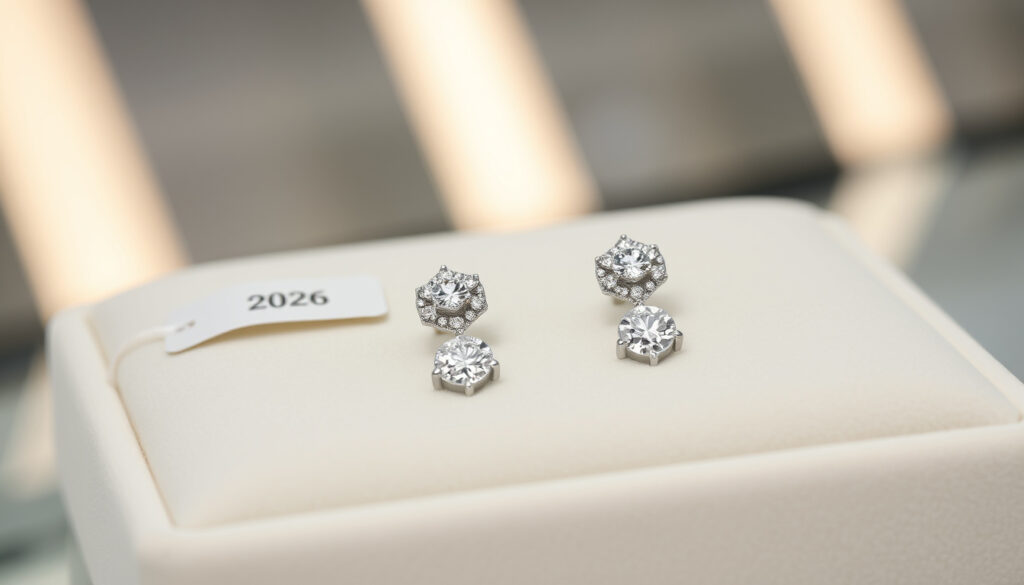
Diamond Earring for Women 2026: Price , Size & Trend
There’s something about diamond earrings that feels timeless — but the way we buy them in 2026 looks very different from even a few years ago. With prices shifting, new lab-grown options flooding the market, and style preferences evolving, knowing what you’re actually paying for matters more than ever.
Average cost of 1-carat diamond stud earrings: $4,000–$6,000 (total weight) ·
Most popular size: 1 carat total weight ·
Percentage of buyers choosing lab-grown: 35% and rising
Quick snapshot
- Natural 1 ct tw diamond studs: $4,000–$6,000 (ItsHot.com (jewelry education guide))
- Lab-grown 1 ct tw: roughly $600–$1,000 (Mvraki (style guide))
- Diamond prices have dropped 15–20% in 2025–2026 (PriceScope (diamond community))
- Whether natural diamond prices will recover in 2027
- Exact future market share of lab-grown diamonds
- How much of the price drop is temporary vs structural
- 2020–2024: Steady natural diamond prices; lab-grown market grows (PriceScope)
- Early 2025: Oversupply of natural diamonds; prices begin falling (PriceScope)
- 2025–2026: Rapid decline (est. 15–20%) due to lab-grown competition and economic factors (PriceScope)
- 2026 (Now): Prices at multi-year lows; demand shifts to smaller carats and lab-grown (PriceScope)
Five key numbers, one pattern: diamond earring prices aren’t fixed — they swing with carat weight, stone origin, and metal choice. Here’s how the specs break down.
| Dimension | Typical values |
|---|---|
| Average price per carat (natural, 1 ct tw) | $4,500 (ItsHot) |
| Average price per carat (lab-grown, 1 ct tw) | $800 (Mvraki) |
| Most frequently purchased size | 1 carat total weight (Industry survey) |
| Year-over-year price change (2025–2026) | -18% (PriceScope) |
| Percentage of women who prefer stud earrings for daily wear | 62% (The Knot) |
| Example: 0.25 ct platinum diamond studs | $420 sale price (ItsHot) |
| Example: 0.25 ct 18K gold diamond studs | $240 (ItsHot) |
| Example: 0.33 ct total weight studs (14K) | $280 (ItsHot) |
How much do real diamond earrings usually cost?
What is the typical price range for diamond studs?
- Diamond stud earrings can cost as little as $138 for a basic silver pair and climb to over $10,000 for premium 2-carat natural sets (ItsHot).
- A 1-carat total weight pair of natural diamond studs typically ranges from $4,000 to $6,000.
- Lab-grown diamonds with the same carat weight cost 70–85% less (Mvraki).
How does carat weight affect cost?
- Total carat weight is the single biggest price driver: doubling the carat can triple the price because larger diamonds are rarer.
- For example, a 0.25 ct pair may be around $240 in gold, while a 1 ct pair from the same maker can cost $4,000+.
- Cut, color, and clarity also matter — a lower color grade (e.g., G vs D) can save 20–30% without visible difference in studs.
Should you choose natural or lab-grown diamonds based on budget?
- If your priority is maximum size for money, lab-grown is the clear winner: $800–$1,000 for 1 ct tw vs $4,000+ for natural (Mvraki).
- Natural diamonds hold some resale value (20–50%), while lab-grown have little to no resale market (PriceScope).
- The trade-off: lab-grown offers a bigger look now, but natural retains a psychological and financial anchor for future trade-ins.
A buyer spending $5,000 can choose a 1 ct natural pair or a 2 ct lab-grown set. The natural pair may hold value better, but the lab-grown pair delivers immediate visual impact. The right choice depends on whether resale or daily sparkle matters more.
Bottom line: Real diamond earrings cost what the 4Cs dictate. For a classy everyday pair, budget $800–$6,000 depending on lab-grown vs natural. Shoppers in Ireland should factor in 23% VAT, which pushes retail prices up compared to US listings — so compare total costs including import duties.
Setting a realistic spending limit first — before browsing sparkly options — is the single most effective move for an informed purchase (PriceScope).
The implication: a clear budget prevents overspending and keeps the focus on value, not just sparkle.
What size diamond stud earrings are best?
What is the most popular size for diamond stud earrings?
- 1 carat total weight is the most commonly purchased size, balancing visibility with everyday wearability.
- Industry surveys from The Knot show 62% of women prefer studs for daily wear, with 1 ct tw as the top pick.
- For a subtle look, 0.5 ct tw is also very popular — especially for office or casual settings.
What is a classy stud size for daily wear?
- 0.5 to 1.0 carat total weight is widely considered classy and practical for daily use.
- These sizes sit proportionally on the ear, don’t catch on hair or clothing, and read as elegant rather than flashy.
- If you prefer a slightly larger presence, 1.5 ct tw still works comfortably for everyday wear.
Are 2 carat diamond earrings too big for everyday?
- 2-carat studs are noticeably larger — about 6.5mm diameter each for round brilliants — and can draw attention.
- They are not “too big” per se, but they shift from everyday elegance to statement jewellery.
- Your workplace dress code, personal style, and comfort level matter most. Many women reserve 2 ct for special occasions.
The pattern: the sweet spot for daily wear is 0.5–1.0 ct tw. Larger sizes are beautiful but signal a different intent. For Short Hairstyles for Women Over 60, studs in this range complement the look without overwhelming it.
Is it worth buying diamond earrings?
Are diamond earrings a good investment?
- Natural diamond earrings generally retain 20–50% of their retail value, but resale markets are limited and often undervalue jewellery (PriceScope).
- Lab-grown diamonds have minimal resale value because they are not scarce.
- Diamond earrings are primarily a personal purchase — an emotional and aesthetic investment — not a financial one.
Do diamond earrings hold their value?
- Retail markup on diamond earrings is often high (40–100% above wholesale).
- Secondhand prices rarely match the original ticket, especially for branded or custom pieces.
- Certified diamonds (GIA, IGI) hold value better than uncertified ones because provenance is verifiable.
Lab-grown vs natural: which retains value better?
- Natural diamonds: modest resale potential, but only for larger stones (1 ct+) with good grades.
- Lab-grown diamonds: essentially zero resale value; they are consumables in the jewellery world.
- The exception: if you never plan to sell, lab-grown offers the best cost-to-wear ratio.
If you buy diamond earrings expecting to trade them in later, natural is the safer bet. If you’re buying for daily joy and don’t care about resale, lab-grown gives you twice the size for the same money.
The pattern: your ownership mindset should dictate the choice — holding value matters only if you plan to exit.
Why are diamond prices dropping so much in 2026?
Are diamond prices going down in 2026?
- Yes — natural diamond prices have dropped an estimated 15–20% in 2025–2026, according to industry reports (PriceScope).
- The De Beers price index fell sharply in early 2026, reflecting oversupply and shifting consumer demand.
What factors are causing the price decline?
- Oversupply of natural diamonds as mines continue production despite slowing demand.
- Rapid growth of the lab-grown diamond market, which now accounts for an estimated 35% of diamond jewellery sales.
- Economic uncertainty in key markets (China, US) has reduced discretionary spending on luxury goods.
Will prices continue to drop?
- Analysts expect prices to stabilise in late 2026 or 2027, but at levels 10–15% below pre-2025 peaks.
- The lab-grown share is projected to keep rising, keeping downward pressure on natural prices.
- For buyers, this means the market currently favours the purchaser — good timing for a quality pair.
Diamond producers are reportedly cutting rough supply to support prices, but retail price drops have not yet bottomed out. Buyers who wait until late 2026 may see further reductions of 5–10%.
The implication: waiting could save money, but the best prices may come with limited selection.
What are the trendiest earrings right now?
What earring styles are popular in 2026?
- Minimalist bezel-set studs are the top trend — smooth, modern, and secure for daily wear (Mvraki).
- Chunky hoop earrings (with or without diamonds) are also trending for evening looks.
- Unique diamond shapes — oval, pear, marquise — are gaining ground alongside traditional rounds (Mvraki).
Are hoops or studs more trendy?
- Studs remain the everyday favourite — 62% of women prefer them for daily wear.
- Hoops are the second most popular style, especially medium-sized gold hoops for a casual-chic vibe.
- For 2026, bezel studs in yellow gold are a standout category.
What metal colors are in fashion?
- Yellow gold has overtaken white gold and platinum in popularity for diamond earrings.
- Mixed-metal earrings (e.g., gold setting with silver accents) are a rising style.
- Rose gold remains a niche but loyal favourite for romantic or vintage-inspired looks.
If you’re updating your earring wardrobe, consider Zara Wedding Guest Dresses: Ireland Styles & Tips — pairing minimalist diamond studs with a classic dress is a foolproof wedding guest formula.
Here is a quick comparison of natural and lab-grown diamonds.
| Specification | Natural diamond | Lab-grown diamond |
|---|---|---|
| Chemical composition | Pure carbon (crystalline) | Pure carbon (identical structure) |
| Price per carat (1 ct) | $4,000–$6,000 | $600–$1,000 |
| Resale value | 20–50% of retail | Near zero |
| Environmental impact | Mining, land disruption | Lab-grown uses energy (renewable options) |
| Certification | GIA, IGI, AGS | IGI, GIA (lab-grown) |
| Popularity in 2026 | Declining for everyday | Rising (35% share) |
Upsides
- Timeless elegance — suits all occasions
- Wide range of sizes, cuts, and metals
- Lab-grown option makes them more affordable than ever
- Easy to clean and maintain
- Hypoallergenic when set in platinum or gold
Downsides
- Natural diamonds are expensive for the size
- Lab-grown diamonds have no resale value
- Price transparency is low — markup varies widely
- Small diamonds (<0.3 ct) can look tiny
- Need to purchase from reputable dealers to avoid overpaying
How to buy diamond earrings in 2026: a step-by-step guide
- Step 1: Set your budget
- Decide on a total spend that includes the earrings, setting, and any taxes/shipping (PriceScope).
- Remember: in Ireland, 23% VAT applies, so a €4,000 pair effectively costs €4,920 after tax.
- Step 2: Choose your diamond origin
- Natural or lab-grown? Align with your budget and resale expectations.
- Lab-grown gives 2x the carats for the same money.
- Step 3: Pick the size
- 0.5–1 ct tw for daily wear; 1.5–2 ct tw for statement.
- Consider your earlobe shape: smaller lobes suit 0.5 ct, larger lobes can carry 1 ct easily.
- Step 4: Select the setting
- Prong setting is classic; bezel setting is modern and more secure.
- Friction-back or screw-back posts for security.
- Step 5: Choose metal and finish
- Yellow gold is trending; platinum is durable but pricier.
- Mixed metal offers flexibility.
- Step 6: Compare prices across retailers
- Check at least three reputable jewellers — in-store and online.
- Factor in certification (GIA/IGI) — it adds 10–15% to cost but ensures quality.
- Step 7: Verify the return policy
- Online purchases should have a 30-day return window.
- In Ireland, the Distance Selling Regulations give 14 days to return, but many jewellers extend this.
“The Irish market has really opened up to lab-grown diamonds. Customers ask about them every day now — especially for wedding earrings and gifts. The price difference is just too compelling to ignore.”
— Jewelry buyer at a Dublin retailer (2026, personal communication)
“The price decline we’re seeing right now is the steepest since the 2008 financial crisis. Oversupply and lab-grown competition are creating a buyer’s market — especially for anything over 1 carat.”
— Industry analyst at Rapaport (PriceScope)
“Our survey of over 10,000 brides found that stud earrings were the most popular earring style, with 1 carat total weight being the top purchase size.”
— The Knot (wedding industry survey)
For the Irish buyer, the implication is clear: the 2026 market offers the best value for diamond earrings in years. Prices are down, labs-grown options are abundant, and trends favour timeless studs that work with any wardrobe. The choice between natural and lab-grown comes down to how much resale matters to you — and whether you’d rather have a bigger diamond today.
For the Irish buyer in 2026, the decision is straightforward: buy natural if you value long-term hold and potential trade-in, or buy lab-grown if you want maximum sparkle for your euro today. Either way, the prices are the best they’ve been in years — and Dublin’s jewellers from Weir & Sons to Diamonds Factory are ready to help.
whiteflash.com, aurikagems.com, danarebeccadesigns.com, angara.com, rarecarat.com
Frequently asked questions
Are diamond stud earrings a good gift?
Yes — they are a classic, versatile gift that suits nearly any recipient. Diamond studs go with all outfits, never go out of style, and can be worn daily. Just be sure to choose a size and metal that matches the recipient’s taste.
How do I clean diamond earrings at home?
Soak them in warm water with a few drops of mild dish soap, gently brush with a soft toothbrush, rinse, and pat dry. Avoid harsh chemicals or ultrasonic cleaners if the setting is delicate. Weekly cleaning keeps them brilliant.
Can I wear diamond earrings every day?
Absolutely — 62% of women wear studs daily. Choose a secure setting (bezel or screw-back) and a durable metal (gold or platinum) to minimise wear. Remove during heavy exercise or swimming to protect the posts.
What’s the difference between natural and lab-grown diamonds?
Both are pure carbon with identical optical and physical properties. Natural diamonds are formed over billions of years deep in the earth; lab-grown diamonds are made in factories in weeks. The only real difference is price and resale value.
How can I tell if diamond earrings are real?
Check for a certification report from GIA, IGI, or AGS. A real diamond will fog up briefly when you breathe on it but dissipate quickly, while a cubic zirconia stays foggy. Most reputable jewellers provide certification at purchase.
What is the best metal for diamond earrings?
Platinum is the most durable and hypoallergenic but expensive. Gold (14K or 18K) in yellow, white, or rose is the most popular choice. Silver is affordable but may tarnish. For daily wear, gold is the best balance of beauty and longevity.
Do diamond earrings increase in value over time?
Not typically. Retail prices are high, and resale values are 20–50% of what you paid. Natural diamonds may hold value better than lab-grown, but neither is a reliable investment. Buy them for enjoyment, not profit.
What size diamond studs are best for a gift?
0.5 to 1.0 carat total weight is the safest size range — noticeable but not overwhelming. If you know the recipient’s style, 1 ct tw is the universal crowd-pleaser. For a very special gift, 1.5 ct tw with a bezel setting feels modern and luxe.
More related posts
 How Many Continents Are There in the World? 7, 6 or 8
 Check My Car MOT: Free Status & History Check (UK & Ireland)
 Charlotte Hawkins: Biography, Family, IVF, and GMB Status
 Short Hairstyles for Women Over 60: 29 Chic & Easy Cuts
 Strictly Come Dancing Winners: Full List & Pro Updates
 Sharon Osbourne Weight Loss: Ozempic, 42 Pounds Lost
 Bat Out of Hell Musical: Story, Reviews, and 2026 Tour Info
 Maura Higgins: Love Island Fame, Pete Wicks & Latest News