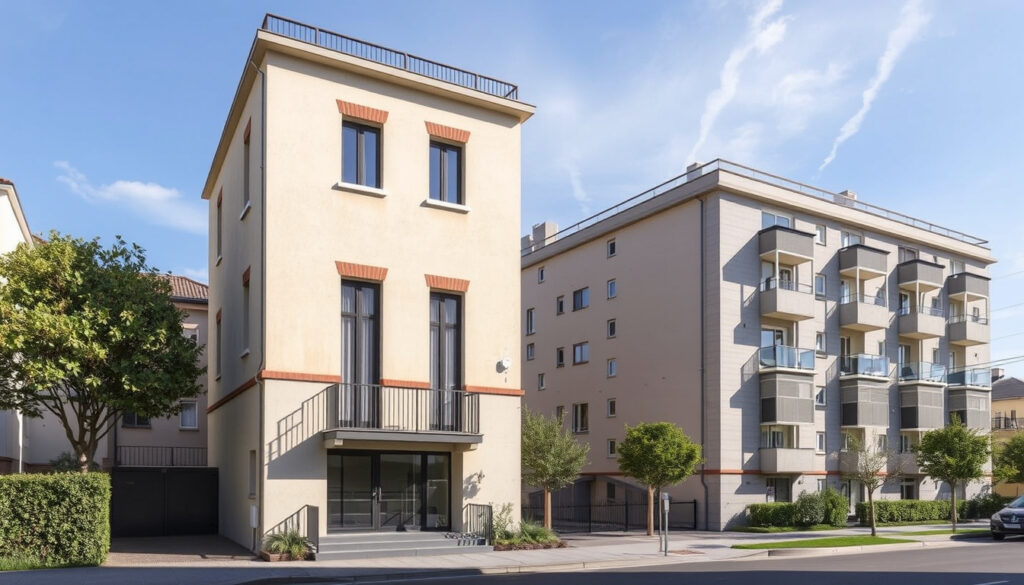
What Is a Maisonette? Definition, Types & Comparison to Flats
You’ve seen “maisonette” on property sites and suspect it’s just a posh word for a flat—but there’s more to it. A maisonette gives you the privacy of your own front door and the space of two floors, yet it sits inside a larger building and typically comes with leasehold conditions.
Typical number of floors: 2 ·
Own front door: Yes ·
Part of a larger building: Yes ·
Common in the UK: Yes ·
Self-contained: Yes
Quick snapshot
- Self‑contained flat on two floors (SAM Conveyancing)
- Own front door (Leysbrook)
- Located within a larger building (Petty Son and Prestwich)
- Internal staircase (The Mortgage Bab)
- Often larger than a standard flat (Leysbrook)
- May have a small garden or balcony (The Mortgage Bab)
- More space and privacy than a flat (Guinness Homes)
- Less expensive than a house (The Mortgage Bab)
- Stairs can be a drawback (Leysbrook)
- Service charges still apply (The Mortgage Bab)
- Young professionals (Guinness Homes)
- Small families (Guinness Homes)
- Downsizers seeking single‑level living on one floor (The Mortgage Bab)
Six facts that define a maisonette at a glance.
| Attribute | Value |
|---|---|
| Definition | A self‑contained two‑storey flat with its own entrance |
| Typical floors | 2 |
| Own entrance | Yes – direct from street or internal corridor |
| Building type | Part of a larger block or converted house |
| Common in | United Kingdom, Ireland, some European cities |
| Legal classification | Usually considered a flat for leasehold/mortgage purposes |
What is a maisonette?
Key features
- According to SAM Conveyancing, a maisonette is typically split across two storeys and accessed by its own front door.
- Leysbrook notes that it has minimal or no communal areas.
- The Mortgage Bab adds that maisonettes may include outdoor space such as a private garden, balcony, or terrace.
Origin of the term
- The word “maisonette” comes from the French maisonnette, meaning “small house.” Guinness Homes says maisonettes first appeared in the UK during the late 19th and early 20th centuries and became popular in London.
The implication is clear: a maisonette is a deliberate architectural middle ground—not quite a house, not a standard flat.
Why is a maisonette not a house?
Legal and planning distinctions
- According to The Mortgage Bab, maisonettes are usually leasehold because the resident does not own the entire building and land.
- Leysbrook confirms that a maisonette sits within a larger building the resident does not own, which is why ground rent and service charges still apply.
Shared structures
- Petty Son and Prestwich warns that some properties marketed as maisonettes actually open onto communal corridors and are better described as split-level apartments.
- Unlike a house, a maisonette typically lacks full land ownership and a standalone garden.
What this means: for mortgage and legal purposes, a maisonette is almost always classified as a flat—so don’t assume you’re buying a house.
What’s the difference between a maisonette and a flat?
Number of floors
- The most common practical difference, per The Mortgage Bab, is that maisonettes occupy more than one level, while flats are usually on one level.
Entrance type
- Leysbrook states that maisonettes have their own front door and minimal or no communal areas, whereas flats share a communal entrance.
Layout and space
- Guinness Homes describes maisonettes as combining features of houses and flats, with more privacy and floor space than a typical apartment.
Six points of comparison, one pattern: the maisonette tries to deliver house‑like living within a multi‑unit building.
| Feature | Maisonette | Flat |
|---|---|---|
| Floors | Two storeys | Usually one storey |
| Entrance | Own front door (direct to outside) | Shared hallway/intercom |
| Ownership | Leasehold typical | Leasehold typical |
| Outdoor space | Often has garden/balcony | Sometimes, but less common |
| Feeling | More like a small house | Apartment feel |
| Typical cost | Higher than a flat, lower than a house | Lower (smaller space) |
Higher leasehold fees than a standard flat often eat into the savings over a house.
The catch: the extra space and private entrance often come with higher leasehold costs than a standard flat.
What are the disadvantages of a maisonette?
Staircase issues
- Internal stairs, while providing a house‑like feel, can be problematic for elderly or disabled residents (Leysbrook).
Service charges and leasehold
- The Mortgage Bab notes that maisonettes still involve ground rent and service charges, similar to a leasehold flat.
Noise and privacy
- If walls are shared with neighbours, noise can be an issue—worse than a detached house but often better than a flat with paper‑thin party walls.
A maisonette gives you extra square footage and a front door, but it won’t free you from the recurring costs of leasehold living. For a young professional, the stairs might be fine; for an older buyer, they could be a deal‑breaker.
The pattern: maisonettes offer space and privacy at the cost of accessibility and ongoing fees.
Who typically lives in a maisonette?
Young professionals
- Guinness Homes suggests maisonettes attract people who want more space than a flat but can’t afford a house.
Small families
- The two‑storey layout is popular among couples with a child who need separate sleeping and living zones (The Mortgage Bab).
Downsizers
- Retirees moving from a large house sometimes choose a ground‑floor maisonette for easier access while still getting a private entrance (Leysbrook).
Upsides
- Own front door and private entrance
- More floor space than a typical flat
- Often has outdoor space
- Can be cheaper than a house
Downsides
- Internal stairs limit accessibility
- Leasehold with ground rent and service charges
- Potential noise from neighbours
- Not a freehold property
The demographics show a clear split: buyers who prioritise space over ease of access gravitate toward maisonettes.
What we know for sure — and what remains unclear
Confirmed facts
- Maisonettes have their own entrance and span two floors (The Mortgage Bab).
- They are a type of flat, not a house (SAM Conveyancing).
- The term originates from French “maisonnette” meaning small house (Guinness Homes).
What’s unclear
- The exact legal definition varies by country and local planning authority.
- Whether a maisonette is classified as a house or flat for mortgage purposes can differ between lenders.
- Some properties marketed as “maisonettes” may be single‑storey, though this is atypical.
A maisonette is commonly described as a self‑contained home that usually spans more than one floor and has its own private entrance.
The Mortgage Bab
Maisonettes combine features of houses and flats, emphasising private entrances and more than one floor.
Guinness Homes
A true maisonette must have a private entrance that opens directly to the outside rather than through an internal communal hallway.
Petty Son and Prestwich
For a first‑time buyer in the UK, the choice between a maisonette and a flat is clear: if you value a front door and extra space without the price tag of a freehold house, a maisonette is the smarter bet. If you need to avoid stairs and want to keep service charges minimal, a flat (or a bungalow) is the safer route.
For a detailed breakdown of how these properties differ, see this maisonette vs flat comparison guide.
Frequently asked questions
Is a maisonette bigger than a flat?
Generally yes. Maisonettes span two floors and tend to offer more square footage than a typical single‑storey flat, according to Leysbrook.
Is a maisonette worth more than a flat?
Often, because they are larger and have a private entrance. The Mortgage Bab notes maisonettes can be cheaper than houses while still offering house‑like features.
Can a maisonette be on one floor?
Rarely. The standard definition requires two storeys. Some single‑level units are marketed as maisonettes, but Petty Son and Prestwich suggests those are better called split‑level flats.
What is a maisonette in Ireland?
In Ireland the term is used similarly to the UK: a self‑contained dwelling on two floors with its own entrance, often part of a larger building.
Which is better, a maisonette or a flat?
It depends. If you want more space and privacy, a maisonette wins. If you need single‑level living or a lower monthly outlay, a flat is usually the better fit.
How does a maisonette compare to a townhouse?
A townhouse is a freehold house on multiple floors with its own land. A maisonette is leasehold and sits inside a larger building, so it’s closer to a flat in ownership structure but house‑like in layout.
For buyers weighing maisonette vs flat, the decision hinges on whether you value private space over convenience.
More related posts
 What Is Net Income? Definition, Calculation, and Examples
 Maura Higgins: Love Island Fame, Pete Wicks & Latest News
 Diamond Earring for Women 2026: Price , Size & Trend
 Sport Shoe Di count Code: 20% Off & Verified Code (May 2026)
 Diane Lane: Biography, Children, Relationships, and Career
 Sharon Osbourne Weight Loss: Ozempic, 42 Pounds Lost
 Who Is on Strictly 2025: Confirmed Cast & Lineup