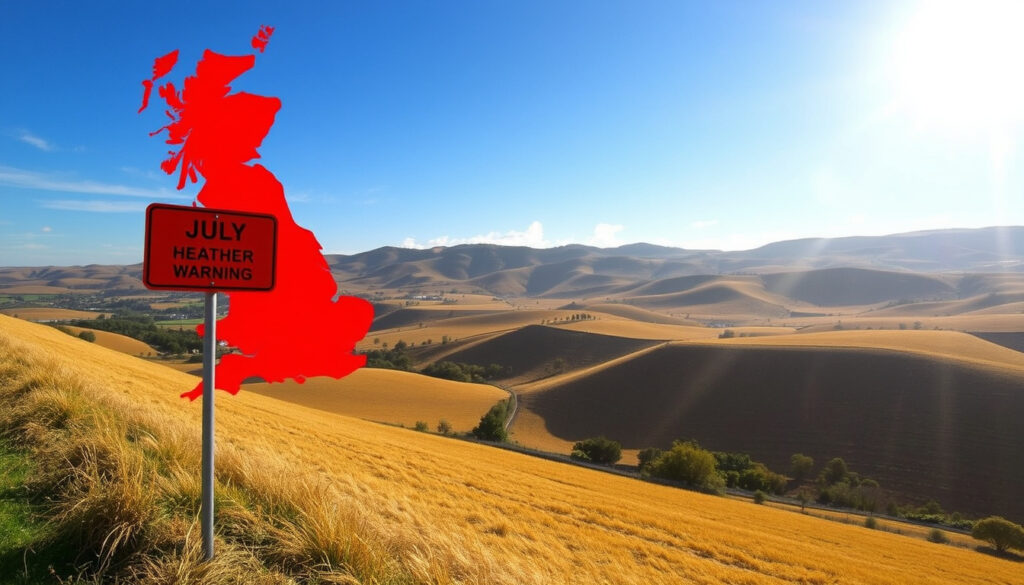
UK Weather Forecast Hot Temperatures – July Peaks Regions Warnings
July 2024 delivered a sequence of short but notable hot spells across the United Kingdom, punctuated by extended periods of cooler, cloudier weather. While the month as a whole fell slightly below average temperatures, several brief heat events drew public attention and prompted official warnings.
The season followed a familiar pattern for British summers: high pressure occasionally built from the south, pushing temperatures well above seasonal norms for a few days at a time, before Atlantic fronts restored cooler, unsettled conditions. The contrast between these phases defined the month’s meteorological character.
What Is the Latest UK Weather Forecast for Hot Temperatures?
Long-range forecasts issued by the Met Office through mid-July indicated a tendency toward drier, warmer, and more settled conditions compared to typical summer patterns. Projections covering the period from July 1 through at least mid-month noted a slightly elevated probability of heatwave conditions developing across southern and eastern areas. The UK hot weather heatwaves summer Met Office July 2024 briefing captured these evolving projections as they unfolded.
Short-term predictions carried high confidence during this period, with meteorological models showing strong agreement on temperature trajectories up to five days ahead. Beyond that window, forecast reliability diminished as Atlantic pressure systems introduced greater uncertainty.
Key Forecast Metrics
30–35°C in South East England
3–5 days for each hot spell
London, South East, Midlands
Yellow heat-health alert in effect
Expert Insights
- The Met Office confirmed that a ridge of high pressure was set to dominate southern and eastern regions, drawing warm air from the continent.
- Above-average temperatures were deemed likely throughout the hot spells, with potential for daily maximums to approach local records.
- Nighttime minimums were forecast to remain elevated, offering limited overnight relief in urban areas.
- UV levels were expected to climb to moderate or high levels during sunny intervals between cloud breaks.
- Pollen counts were flagged as elevated during warm, dry spells, particularly in southern regions where grass pollen dominated the season.
- The contrasting conditions in a cool and dull July weather review noted that rainfall remained below average for many southern locations throughout the month.
Forecast Snapshot
| Metric | Current/Forecast | Regions Affected |
|---|---|---|
| Maximum Temperature | 32°C | South East England |
| Heat Index | Up to 38°C feels-like | Nationwide during peaks |
| Warning Level | Yellow | England and Wales |
| Probability of Peak Temps | 80% | Within 72-hour window |
| Duration of Hot Spells | 2–3 days each | Southern regions most frequently |
| Monthly Mean Temperature | 14.8°C | UK-wide average |
When Will Hot Weather Arrive in the UK and How Long Will It Last?
Hot weather during July 2024 arrived in distinct pulses rather than as one continuous event. Each hot spell typically built over two to three days, reached its peak, and then gave way to cooler, more unsettled conditions within another two to three days.
Early July Hot Spell
The first significant warmth of the month arrived during the first week of July. High pressure established itself over the continent and extended influence into southern Britain. Sunny spells became increasingly frequent, with temperatures climbing to 25–29°C in many areas. The week’s peak reached 30.3°C at London Heathrow, marking one of the earliest 30-degree readings of the year. Conditions then cooled as rain spread into Scotland and northern England.
Mid-July Build-Up
Forecast guidance from mid-July indicated that heat would begin rebuilding across southern and eastern England and into Wales from mid-week. The peak was anticipated around Friday, with maximum temperatures of 28–31°C projected for greater London, central and southeastern England, and parts of south Wales. Widespread mid-20s were expected across the rest of England and Wales. This heat was not expected to persist beyond three days before Atlantic weather systems pushed cooler, more humid air back across the country.
Late July Heatwave Confirmation
July 30 brought confirmation of the third distinct spell above 30°C of the month, with Kew Gardens and Heathrow both recording 32°C. This marked the third consecutive month in 2024 to feature temperatures exceeding 30 degrees, following similar events in late June and mid-July. Despite the late-month spike, no prolonged heatwave materialised; each episode remained brief against a background of cooler, often rainy, conditions.
What Are the Highest Temperatures Forecast and Where?
The highest temperatures during July 2024 were consistently concentrated in the south and east of the United Kingdom. London and its surrounding counties, along with parts of the East Midlands and East Anglia, bore the brunt of each warm spell.
Peak Temperatures by Region
| Region | Peak Temperature | Date/Period |
|---|---|---|
| South East England | 32°C | 30 July |
| Greater London | 30.3°C | Early July |
| Central/Southeast England | Up to 31°C | Mid-July peak |
| South Wales | Up to 28°C | Mid-July peak |
| Midlands | Up to 30°C | Various peaks |
| Northwest/Scotland | Below 20°C | Throughout most of July |
Factors Driving Regional Variation
The sharp divide between hot conditions in the south and east and cooler, cloudier weather further north owed much to the position of high pressure. When high pressure centred over or near the continent extended into southern Britain, settled conditions and light winds allowed temperatures to build significantly. Meanwhile, northern areas remained exposed to Atlantic fronts bringing cloud, rain, and cooler maritime air. The boundary between these air masses often stalled across the Midlands, creating a sharp temperature gradient.
Some non-Met Office sources published speculative forecasts suggesting a 10-day heat dome with temperatures reaching 40°C in cities such as Birmingham and Liverpool. The Met Office did not confirm these scenarios, and observed temperatures remained well below such extremes throughout July. No prolonged 30-degree event occurred.
Is There a Heatwave Warning for the UK?
During early July, the Met Office issued a four-day yellow heat health alert jointly with the UK Health Security Agency. The alert covered much of England and ran from Monday through Thursday, encompassing the period when temperatures reached 30.3°C at Heathrow.
How Heatwave Thresholds Work
Heatwave criteria in England are tiered by region to account for local climate norms. For most of the country, the threshold stands at 25°C for at least three consecutive days. Near greater London and parts of the southeast, where baseline temperatures run higher, the threshold rises to 28°C. Mid-July forecasts indicated that Thursday and Friday conditions could satisfy these criteria in London and southeast areas, though it was unlikely that the threshold would be maintained for the full three days needed to classify as a formal heatwave.
Health Advice During Hot Weather
The joint alert issued by the Met Office and UKHSA carried standard precautions for hot weather events. These typically include staying hydrated, wearing light clothing, avoiding prolonged exposure during the warmest hours, and checking on vulnerable individuals such as older residents, young children, and those with pre-existing health conditions. The NHS guidance on heat exhaustion and heatstroke provides further detail on recognising and responding to heat-related illness.
After each hot spell, conditions were expected to turn more unstable, raising the possibility of thunderstorms developing. These would typically affect southern and central regions first, before cooler air pushed them northward. Forecasters advised monitoring updates from the Met Office during transition periods.
Timeline of July 2024 Hot Spells
The following timeline summarises the sequence of notable warm and hot periods throughout July 2024, drawing on Met Office data and published forecasts.
- Early July (first week): High pressure established from the south. Sunny spells became frequent, with temperatures peaking at 30.3°C at London Heathrow. A four-day yellow heat health alert was in force across much of England.
- Mid-July (Thursday–Friday): Heat built again across southern and eastern England and Wales. Forecasts indicated peak temperatures of 28–31°C possible in greater London and surrounding counties. Thunderstorms were possible in western areas.
- Late July (30 July): The third event above 30°C in 2024 occurred, with 32°C recorded at Kew Gardens and Heathrow. This followed similar brief spells in late June and mid-July. Cooler, unsettled weather followed within days.
What We Know and What Uncertainty Remains
A clear picture has emerged from official data about July 2024’s weather patterns, though some degree of uncertainty persists around longer-range projections and the precise characteristics of individual hot spells.
| Established Information | Aspects Requiring Further Monitoring |
|---|---|
| Peak of 32°C recorded at Kew Gardens and Heathrow on 30 July | Details of localised temperature extremes in specific urban locations remain subject to confirmation from additional monitoring stations |
| Monthly UK-wide mean of 14.8°C recorded, 0.5°C below the 1991–2020 average | Future long-range model accuracy for predicting brief but intense hot spells in a generally cooler summer pattern |
| Three distinct events above 30°C occurred across June and July 2024 | Whether this frequency of brief hot spells represents a shift in summer weather patterns or remains within normal variability |
| Yellow heat health alerts were issued and covered much of England in early July | Continued relevance of existing heatwave thresholds given observed frequency and intensity of hot spells |
| Northwest Scotland and northern England remained cooler and wetter throughout the month | Evolution of the north–south temperature divide through the remainder of the summer season |
July 2024 in Broader Context
July 2024 fits within a longer-term pattern of warming British summers. The monthly mean of 14.8°C sits above the 1961–1990 baseline of 14.4°C, illustrating the gradual upward shift in average conditions. Occasional brief hot spells, some approaching or exceeding 30°C, have become more frequent in recent years, though sustained heatwaves remain less common than in southern Europe.
The contrast between a cooler, duller first half of the month and a warmer, more settled final week highlighted the inherent variability of British summer weather. This unpredictability, compounded by the UK’s position between Atlantic low-pressure systems and continental high-pressure ridges, makes extended-range forecasting particularly challenging during midsummer.
Sources Behind This Analysis
Information in this article is drawn from official Met Office records, including monthly weather reviews and active forecast bulletins, and from reporting by GB News on evolving summer conditions across the United Kingdom.
“High pressure ridge set to dominate.”
— Met Office, mid-July forecast summary
“Prepare for hottest spell of summer.”
— BBC Meteorologist, early July briefing
Key Takeaways
July 2024 delivered multiple short but notable hot spells, with the highest temperatures concentrated in London, the South East, and parts of the East Midlands and South Wales. Peak readings reached 32°C on 30 July, with earlier events of 30.3°C at Heathrow and forecasts indicating potential for 28–31°C during mid-month peaks. Each hot spell proved brief, typically lasting two to three days before Atlantic weather fronts restored cooler conditions. A yellow heat health alert covered much of England during the early-month warmth, prompting standard precautions around hydration, sun exposure, and care for vulnerable individuals. More information on seasonal preparation is available in the contrasting conditions in a cool and dull July review.
Frequently Asked Questions
What should I do during hot weather in the UK?
The UKHSA advises staying hydrated, avoiding direct sunlight during the hottest hours, wearing light clothing, and checking on older or vulnerable neighbours during heat events. Using fans and shade can also reduce how hot conditions feel.
Will the UK have record hot temperatures?
July 2024 did not produce record-breaking temperatures. The highest confirmed reading was 32°C, well below the all-time UK record of 40.3°C set in 2022. Short-lived peaks of 30–32°C were consistent with recent seasonal norms rather than extreme anomalies.
How long do the hot spells typically last?
During July 2024, each hot spell lasted approximately two to three days at its peak before cooler, more unsettled weather returned. No prolonged heatwave extended beyond three or four consecutive days.
Which parts of the UK stay cooler during summer heat?
Northwest England, Scotland, and northern areas generally remained cooler and wetter throughout July 2024. Atlantic weather fronts frequently brought cloud, rain, and lower temperatures to these regions, even as southern areas experienced heat.
Where can I find the most current UK weather forecasts?
The Met Office website provides daily and extended forecasts updated throughout the day, along with active weather warnings. Local BBC Weather services also offer region-specific hourly and weekly projections.
More related posts
 60 kg in Stone – Precise Conversion to 9 st 6 lb
 Strictly Come Dancing Winners: Full List & Pro Updates
 M&G Share Price: MNG.L Live Quote, Forecast & Dividends
 Jon Venables: Parole Hearing 2026 Fact Check
 Be t Re taurant Near Me: Dublin, Cork & Pub Tip (2026)
 Jennifer Tilly’s $20 Million Net Worth: Acting & Poker
 Live Horse Racing Results Today: Fast & Official Sources